I've decided that this is the year to try cold frames out. Mostly, I think that they'd be tremendously helpful in improving my hardening off process for my warm weather seedlings since, as we know from years past, my hardening off method is haphazard at best. I figure that a cold frame will give the little guys a much better chance at not being sunburned and/or eaten by Bullet and Lily. Since we don't have a root cellar, and have minimal winter storage abilities, I'm also really intrigued by the idea of being able to continue to harvest fresh vegetables through the winter. Mike and I had a surprisingly animated conversation about the proper placement of the cold frames (this is an issue that we both apparently have strong feelings about, but I won in the end. Or at least, I think I did), and I think we've settled on building three 3x10 cold frames on the south side of the garden. Mike wanted the cold frames in the garden, but I think that would just be too hard to get to in the winter.
We're using Eliot Coleman's Four Season Harvest as a guide for how to build and use our cold frames, and so I need to come up with a plan (and possibly, more seeds) for this experiment.
Cold Frame 1 (closest to house - winter and spring harvest)
Arugula (plant 8/1-8/21, harvest 10/1 - spring)
Endive (plant 7/10-7/20, harvest 9/15-11/30)
Escarole (plant 7/10-7/20, harvest 9/15-11/30)
Lettuce (plant 7/21-9/7, harvest 9/15-11/30, plant again 9/15-10/15, harvest 3/1-5/1)
Onion (plant 10/1-10/15, harvest 2/15-5/1)
Spinach (plant 10/1-10/15, harvest 2/15-5/1)
Parsnip (plant 6/1, harvest spring)
Chives
Oregano
Thyme
Swiss chard (plant 6/1-9/10)
Kale (plant 7/15-9/1)
Leek (plant 7/1-8/15)
Broccoli rabe (Plant 1/15)
*According to Coleman, I can plant succession plantings for the spring of arugula, broccoli raab, carrots, claytonia, cress, endive, escarole, lettuce, mache, mizuna, orach, parsley, peas, purslane, radicchio, radishes and spinach in mid-January*
Cold Frame 2 (middle - fall and winter harvest)
Carrots (plant 8/1, harvest 12/1 - Spring)
Kohlrabi (plant 8/1 - 8/15, harvest 11/1 - spring)
Parsley (plant 6/1-7/15, harvest 10/1-spring)
Spinach (plant 9/15-10/15, harvest 12/1-spring
Beets (plant 8/1, harvest 12/1 - spring)
Radish (plant 9/1-10/15, harvest 10/1-11/30)
Scallion (plant 7/1-7/15, harvest 10/1-spring)
Turnip (Plant 8/1-9/15)
Cold Frame 3 (furthest from house - home base for summer/fall seedlings)
Since we probably won't have the cold frames built until at least March or April, this bed will primarily be used to house the seedlings that we're hardening off. Maybe I can also start some seedlings in here as well for fall succession crops? I have to do more reading.
Wednesday, January 23, 2013

Saturday, January 5, 2013
Planning the orchard
Another list oriented post. We have big dreams for the orchard, and would like to cultivate as many of the more rare New England apple varieties as possible. We'd also like to add plums, and perhaps some more peaches, pears, and cherries. I also have visions of some sort of small structure to support vining kiwi plants. Wouldn't that be pretty? And, at the border on the fence, blueberry and elderberry bushes, along with some other beneficial plants to help our organic orcharding endeavor. For next year, we're going to focus on clearing out the scraggly pine trees that are currently occupying the land that we'd like to devote to the orchard, and will plant four new apple trees. In a separate part of the property, we'll also start our raspberry and blackberry stands. Of course, we planned out the varieties that we'd like, complete with a long range plan, several months ago, and I've now lost it. Or the baby ate it. Or something. I hope it turns up again, as it was quite thorough and I've forgotten nearly all of the details (like, how many raspberry bushes did I want?).
We made a new list! And got a bit overexcited in the tree clearing process, so we're going to order more fruit trees than I originally planned. I suspect that this is all because Mike wants to have another tractor weekend, but that's fine with me. We have room now for a total of 15 more trees, and could expand further. But that would probably be excessive. Probably.
Apple trees:
Black Oxford Apple Winter. Unknown parentage. Paris, Oxford County, ME, about 1790. This outstanding apple, a favorite long ago around much of Maine, has been making a huge comeback in the last 20 years. Our best seller until Honeycrisp came along. Medium-sized round fruit, deep purple with a blackish bloom. From a distance you might think you’d discovered a huge plum tree. Last summer I revisited the Hallowell, Maine, tree planted by Benjamin Vaughan in 1799. Still hanging in there! Excellent pies, superb late cider. Leave the skins on for a delightful pink sauce. Best eating late December to March. They get sweeter and sweeter as the months go by. Good cooking until early summer. Some insect and disease resistance. Unusual light pink blooms, early midseason. Z4-5. Both are ME Grown
Sweet Sixteen Apple Fall. MN 1630 (MN447 x Northern Spy) U Minn, 1979. Whenever anyone eats a Sweet 16 for the first time, you know they will be surprised. Fine-textured crisp flesh contains an astounding unusually complex combination of sweet, nutty and spicy flavors with slight anise essence, sometimes described as cherry, vanilla or even bourbon. I always love Sweet 16 season. Truly excellent fresh eating, although it is too sweet for some palates. Round-conic bronze-red medium-sized fruit, striped and washed with rose-red. Annual bearer if thinned. Very hardy moderate-sized vigorous vase-shaped tree grows upright with willowy branches that get loaded with fruit but do not break. Grower-friendly. Reaches its best flavor and texture in northern districts. Some resistance to scab. Keeps till midwinter. One of the wonderful progeny of (#118) Frostbite. We hope to introduce more of them! Blooms mid to late season. Z3-6. ME Grown.
Chestnut Apple Early Fall. MN 240 (Malinda x open-pollinated) U Minn, 1946. A lot of people love this apple. Small golf-ball-sized fruit with truly excellent fresh-eating qualities. Yellow and bronze-red skin with some russeting. Firm crisp juicy fine-grained very sweet yellowish flesh. The apple version of Sun Gold tomato—fabulous complex flavor in a small package. For a growing number of people in central Maine, late September is Chestnut apple time. Every year we put out a bushel a day at Fedco’s booth at the Common Ground Fair and watch them disappear. Neophytes often look at the fruit with disdain. Most however take one bite and their frowns turn to smiles. (For some, despite its crispness and depth of flavor, it is too sweet.) Chestnut needs no sugar to make a sweet and subtle sauce. Not a keeper, but can be stored for a month or so. Vigorous, somewhat weeping, medium-sized productive tree. Disease resistant. Also beautiful in bloom, midseason. Z3-5. ME Grown.
Calville Blanc d’Hiver Apple Winter. Unknown parentage. France or Germany, 16th century. Also called White Winter Calville. Famous as a dessert and cooking apple for over 400 years. Steve Wood of Poverty Lane orchards in Lebanon, NH, called it “the best culinary apple in the world.” Large flattish pale green-yellow fruit with uneven lumpy ribs and a dotted orange-red blush. Creamy-white aromatic fine-grained juicy flesh with a sweet distinctive effervescent flavor. Smooth when baked. Recommended for vinegar, fresh cider and as a sharp (acid) component in fermented cider. Should be stored a month to reach peak flavor. Will keep until midwinter. Very vigorous strongly upright vase-shaped tree with good branch angles. Head the tree if necessary to force it down. Not for coldest areas though certainly hardy to Zone 4. Blooms midseason. Z4-7.
Winekist Apple Summer. Unknown parentage. Morris Towle introduction, Winthrop, ME, 20th c. A very high-quality red-fleshed all-purpose fruit. Skin is wine red with areas and stripes of darker red and very small white dots; the overall effect is dark red by mid July. Very juicy coarse firm flesh is almost solid beet red: a real eye popper! Ripens about September 10 in central Maine. Medium-small fruit is quite good for fresh eating and a great addition to cider or sauce. Leaves are tomentose (soft and woolly) and have a dark reddish cast to them. Blossoms are light pink. Wood, when you cut into it, is pink. Tree is a natural semi-dwarf. Developed by the orchardist and variety collector Morris Towle (1911-1993). Saved for posterity by orchardist and collector Earland Goodhue of Sidney. Bears young and annually. Blooms early to midseason. Z4-6. ME Grown.
Enterprise Apple Fall-Winter. Coop 30 [PRI 2693-1=(PRI 1661-2 x PRI 1661-1)] PRI introduction, 1993. From the well-known Purdue-Rutgers-Illinois apple breeding program—one of the most highly recommended new dessert varieties in years. Medium-large roundish red-orange fruit is crisp, firm, juicy with a rich spicy flavor. Stores for 6 months or more. Flavor improves in storage, with best eating about a month into winter. Longtime readers of the Fedco Trees catalog know that I remain a bit of a sceptic when it comes to new varieties. “Show me the beef!” I say. I was reluctant to pay much attention to Enterprise for years, but now have added it to my list of varieties worth planting. Two of my favorite Maine growers, Steve Meyerhans of Fairfield and Joe Vachon of Stetson, are among those who have raved about this fruit. Annual bearing, scab immune, resistant to powdery mildew, cider-apple rust and fireblight. Blooms late-season. Z4-7.
Cox’s Orange Pippin Apple Fall. Possibly a seedling of Ribston Pippin. Near Slough, Bucks, England, around 1825. Deservedly one of the three or four most famous of all apples. Not only one of the best eating apples ever but also one of the most sought-after varieties in modern apple breeding; parent or grandparent of many other varieties. Revered in the U.K. Medium-sized all-purpose aromatic fruit is red-orange to red with orange russet striping and wash. Perfectly balanced slightly subacid flavor and crisp juicy tender flesh improve with storage. Moderately vigorous moderately productive tree bears young and annually. Prefers cooler climates and higher pH (6.5-7.5+). The oldest Maine Cox’s I know is about 40 years old, thriving in Mercer, Zone 4. Scab resistant. Blooms midseason. Z4-6.
Pear Trees:
Seckel Pear Late Summer. Seedling near Philadelphia, PA, early 1800s. Sometimes called Sugar Pear. Often considered the best-flavored of all pears; even the skin is delicious. Small obovate fruit is yellowish-brown russeted with slight red blush. Juicy, spicy, distinctive and aromatic. Eat ripe off the tree or pick firm and ripen later. We use Seckels to make our baked “applesauce.” It’s wonderful. Very productive annual-bearing large tree, easy to grow. The most reliably bearing fruit tree we have. Scab- and fireblight-resistant. Will not pollinate Bartlett. Z4. ME Grown.
Sweet Cherries:
Gold Cherry Summer. Chance seedling. Stark Bros Nursery introduction, Louisiana, MO, about 1932. Also called Stark Gold for Stark Gold Sweet Cherry. Medium-sized crack-resistant fruit has translucent golden-yellow skin and firm flesh of exceptionally good quality. Originally selected for maraschino cherry processing, but its hardiness and good taste made it an excellent choice for northern sweet-cherry growers. Very productive large tree. Ripens late. Developed or selected by CJ Thomas in Rulo, Nebraska, and subsequently released by Stark Bros. Grown commercially in some areas. Z4/5.
Kristin Cherry Summer. NY1599 (Emperor Francis x Gil Peck) Geneva, NY, 1982. Large very dark red or purplish-black fruit. Firm juicy red flesh is rich, sweet and delicious. Good resistance to fruit cracking. Tested in Montana, Norway (the country, not Maine) and New York and considered to be relatively hardy for a sweet cherry, possibly including protected areas of Zone 4. Ripens in mid-July. Z4/5.
Peaches:
Polly Peach Mid. SA Beach and TJ Maney intro, University of IA, 1932. Medium-sized white-fleshed freestone fruit. Whitish skin with a reddish blush. Reliable cropper. Blooms later in the season. Considered the hardiest white-fleshed peach. Probably a cross of Bailey and Prunus davidiana. Perhaps the name was inspired by Bertolt Brecht’s infamous Polly Peachum, wife of the even more infamous Macheath—Mack the Knife. Zone 5 or maybe Zone 4.
Plums:
Black Ice Plum Midsummer. Prunus Lydecker [Prunus besseyi x (Prunus salicina Oka x Prunus salicina Z’s Blue Giant)] U of Wisc, River Falls, 2006. Large 2" round early-ripening high-quality hardy blue-black dessert plum. Very sweet juicy reddish-purple semi-freestone flesh. Precocious and productive tree with a naturally compact growth habit. Bred by Brian Smith who I visited a few years ago on a fruit exploration trip in the Upper Midwest. He graciously showed us all through his amazing nursery in River Falls. He was growing many of his plums in huge tubs, manipulating bloom time using greenhouses and coolers. This enabled him to cross species or varieties that would never normally flower together. Though we’re not fans of plant patenting, we have been eager to offer his first major introduction. PVP 16621. The literature recommends Toka or La Crescent as a pollinator. Now on trial at our farm. Z3.
La Crescent Plum Late Summer. (Prunus salicina Shiro x Prunus americana Howard Yellow) U Minn, 1923. Also known as Golden La Crescent or Golden Minnesota. Most of the hybrid plum varieties are colored with some variation of red and orange with a little purple tossed in. Yellow-skinned La Crescent is one notable exception. The beautiful roundish tender thin-skinned yellow fruit is sometimes blushed with a little pink. Tender yellow juicy flesh of excellent quality is sweet, aromatic and suggestive of apricots. Freestone. Upright spreading vigorous tree. Z3/4.ME Grown.
Blueberries:
Bluejay Highbush Blueberry Early-Mid. HBS400 [Berkeley x Michigan 241 (Pioneer x Taylor)] Michigan State U, 1978. Medium-large firm mild-flavored light blue berries with high sugar content. One of the best blueberries for eating, freezing, canning, and preserving. Loose clusters easily harvested by hand or machine. Productive bush is vigorous and upright, slightly spreading. Grows fast, 5–7’ tall. Disease resistant. Z4. ME Grown.
Jersey Highbush Blueberry Mid-Late. (Rubel x Grover) USDA, 1928. The beloved old standard of blueberry introductions to which new varieties are compared. Medium-to-large dark blue berries in large loose clusters. Vigorous erect hardy bush, 5-7' tall. Productive, widely grown, adapted to a wide range of soils, highly praised, easy to grow and suited to the New England climate. Z4. ME Grown.
Northland Highbush Blueberry Early. (Berkeley x 19-H) Mich St U, 1967. Early highbush x lowbush type bears long loose clusters of medium-small dark blue berries with excellent wild flavor. Very vigorous and productive, 3' moderately spreading bush has limber branches which tolerate snow well. Good for landscaping, bird forage and dessert. Hardy. Z3. ME Grown.
Raspberries and black raspberries:
For 2013!
Latham Summer-bearing Raspberry Mid. MN4 (King x Loudon) U. Minn 1920. A standard raspberry for almost a century, extremely popular and widely grown. Large bright red 1" fruit is roundish, firm, a little crumbly and sprightly sweet, full-flavored and aromatic. Great for fresh eating, canning, freezing, jam, juice, or pie. Ripens over an extended season making it an ideal candidate for the home garden. Canes are 4–5' tall and highly productive. Widely adaptable and very winter hardy, not as spiny as most raspberries, disease resistant. Z3.
Prelude Summer-bearing Raspberry Early. NY 1009 (NY 817 x Hilton) NY Stn 1998. Ripens very early and produces a second small crop in the fall, just when you are starting to miss raspberries. Very large red conic fruit is firm and high-quality. Flavor is mild with little acidity but very tasty. Vigorous winter-hardy canes. After several years of trial at John and Pat Meader’s Hardy Maine Nursery in Buckfield, John wrote, “I’d strongly recommend Prelude. It showed hardiness equal to Boyne last winter and fruits the earliest of all varieties I’ve observed (over 30)…Prelude would preceed Boyne nicely; it has good fruit (taste, firmness, size) and seems quite productive; it fruits well over two full weeks.” Suckers freely. Z4.
Royalty Purple Summer-bearing Raspberry Mid. (Cumberland x Newburgh) x (Newburgh x Indian Summer) NY Stn, 1982. Cohesive fairly firm large berries make outstanding jam and jelly and even better fresh eating. Their distinctive flavor is different from the red raspberries, with a hint of black raspberry. Extremely robust minimally suckering plants are very productive and open-formed; the berries are right in your face and easy to pick. Ready to harvest when they are deep purple, somewhat later than the reds. Plant in hills (see sidebar). Usually considered Zone 4 but is proving itself into Zone 3 with occasional slight tip dieback. Does not like wet soil. Disease resistant. Z3-4.
Jewel Black Raspberry Midseason. Bristol x Dundee. Cornell, Geneva, NY. High-yielding variety boasts superb quality and flavor. Glossy large firm juicy fruit melts in your mouth with rich, sweet, lingering flavor. Larger than Bristol. Excellent choice for fresh eating, jams and jellies. Keeps its shape for several days with refrigeration. Black raspberries have been called the “King of Fruits” because of their high levels of antioxidants and anthocyanins which give the berries their dark color. A cure-all for many health conditions; strengthens immune system if eaten regularly. Freeze excess berries and eat them through the winter months to help prevent colds and flus. Vigorous disease-resistant canes. Z4.
Blackberries:
One of my first foods, and something I'm looking forward to introducing to Landon!
Nelson Blackberry Midsummer. Virtually all commercial blackberry varieties are notoriously vigorous but tender up north. You wind up with an annual mess of thorny fruitless groundcover. Nelson has been surviving Maine winters for at least a century. Introduced to us by the descendants of Nelson Fronk whose 1928 family photograph taken on their farm northeast of Farmington shows the blackberry growing next to the barn. John Meader, who grows it for Fedco, calls it “exceptionally hardy,” in fact, one of the most enduring blackberries he has ever grown. The inch-thick canes are tall, sturdy and upright. They can be grown on posts but also do well free standing. Fruit is moderately large, quite juicy and, when ripe, it has a sweet, true blackberry taste. What really makes this blackberry a standout is its high productivity: 16–18 blossoms on the central blossom stalk is the highest John has ever seen on a blackberry. He gets four good pickings from his patch over two weeks in mid-August. Nelson makes excellent jelly and is good to eat right from the bush. Disease resistant and, like all blackberries, spreads quickly so give it room to move. We recommend planting in Zone 4 or maybe Zone 3. ME Grown. (well-rooted bare-root canes)
Elderberries:
Sambucus canadensis ‘Adams No. 1’ Elderberry NY State Ag Experiment Station introduction, 1926. Large berries and fruit clusters make for easy and fast picking. If you’re heading to a potluck and need to make a pie in a pinch, Adams is the shrub you want. Excellent for preserving and not bad fresh-eating. Very large vigorous strong productive bush. In one of our Maine nurseries, this variety was the mother of all elderberries, reaching 12' in height and the same across. It lived for many years as the centerpiece in the garden and provided a year’s worth of berries every season. Selected in 1915 from the wild by William Adams in Union Springs and sent to Geneva where it was introduced 11 years later. ME Grown.
Sambucus canadensis ‘Fryeburg Intervale’ Elderberry Fedco introduction, 2013. Not a distinct variety, but an ecotype. Selected and propagated by Ryan Bushell of Burnt Meadow Nursery, Brownfield, ME, using cuttings he collected from multiple Saco River flood plain plants located in the hedgerows and uncultivated areas of the Fryeburg Intervale. Plants produce large clusters of berries causing branches to arch under their weight. Somewhat compact habit, often being wider than tall. Expect variability as cuttings were selected from multiple plants. Much cold air drains down the Saco River valley, and temperatures have gone as low as –35° recent years. These plants should be very hardy. Jen reports that they are prolifically setting fruit in their second year in the nursery. ME Grown
We made a new list! And got a bit overexcited in the tree clearing process, so we're going to order more fruit trees than I originally planned. I suspect that this is all because Mike wants to have another tractor weekend, but that's fine with me. We have room now for a total of 15 more trees, and could expand further. But that would probably be excessive. Probably.
Apple trees:
Black Oxford Apple Winter. Unknown parentage. Paris, Oxford County, ME, about 1790. This outstanding apple, a favorite long ago around much of Maine, has been making a huge comeback in the last 20 years. Our best seller until Honeycrisp came along. Medium-sized round fruit, deep purple with a blackish bloom. From a distance you might think you’d discovered a huge plum tree. Last summer I revisited the Hallowell, Maine, tree planted by Benjamin Vaughan in 1799. Still hanging in there! Excellent pies, superb late cider. Leave the skins on for a delightful pink sauce. Best eating late December to March. They get sweeter and sweeter as the months go by. Good cooking until early summer. Some insect and disease resistance. Unusual light pink blooms, early midseason. Z4-5. Both are ME Grown
Northern Spy Apple Winter. Chance seedling. East Bloomfield, NY, about 1800. One of the most famous of all heirloom apples. Very large delectable all-purpose pink fruit has yellow background covered all over with pink and light red stripes. Very juicy and tender. Even when the soft skin bruises, the fruit keeps extremely well. Cooks up quickly into a loose mild sauce. No need to remove the skins. Its reputation as a pie apple is more than well deserved: makes a very good single-variety pie! Its one drawback is being slow to come into bearing, although for us it’s been worth the wait. Medium-to-large moderately vigorous long-lived tree. Prefers fertile well-drained soil. Good scab resistance. Leafs out late and blooms late season. Z4-6. Both are ME Grown.
Chestnut Apple Early Fall. MN 240 (Malinda x open-pollinated) U Minn, 1946. A lot of people love this apple. Small golf-ball-sized fruit with truly excellent fresh-eating qualities. Yellow and bronze-red skin with some russeting. Firm crisp juicy fine-grained very sweet yellowish flesh. The apple version of Sun Gold tomato—fabulous complex flavor in a small package. For a growing number of people in central Maine, late September is Chestnut apple time. Every year we put out a bushel a day at Fedco’s booth at the Common Ground Fair and watch them disappear. Neophytes often look at the fruit with disdain. Most however take one bite and their frowns turn to smiles. (For some, despite its crispness and depth of flavor, it is too sweet.) Chestnut needs no sugar to make a sweet and subtle sauce. Not a keeper, but can be stored for a month or so. Vigorous, somewhat weeping, medium-sized productive tree. Disease resistant. Also beautiful in bloom, midseason. Z3-5. ME Grown.
Calville Blanc d’Hiver Apple Winter. Unknown parentage. France or Germany, 16th century. Also called White Winter Calville. Famous as a dessert and cooking apple for over 400 years. Steve Wood of Poverty Lane orchards in Lebanon, NH, called it “the best culinary apple in the world.” Large flattish pale green-yellow fruit with uneven lumpy ribs and a dotted orange-red blush. Creamy-white aromatic fine-grained juicy flesh with a sweet distinctive effervescent flavor. Smooth when baked. Recommended for vinegar, fresh cider and as a sharp (acid) component in fermented cider. Should be stored a month to reach peak flavor. Will keep until midwinter. Very vigorous strongly upright vase-shaped tree with good branch angles. Head the tree if necessary to force it down. Not for coldest areas though certainly hardy to Zone 4. Blooms midseason. Z4-7.
Winekist Apple Summer. Unknown parentage. Morris Towle introduction, Winthrop, ME, 20th c. A very high-quality red-fleshed all-purpose fruit. Skin is wine red with areas and stripes of darker red and very small white dots; the overall effect is dark red by mid July. Very juicy coarse firm flesh is almost solid beet red: a real eye popper! Ripens about September 10 in central Maine. Medium-small fruit is quite good for fresh eating and a great addition to cider or sauce. Leaves are tomentose (soft and woolly) and have a dark reddish cast to them. Blossoms are light pink. Wood, when you cut into it, is pink. Tree is a natural semi-dwarf. Developed by the orchardist and variety collector Morris Towle (1911-1993). Saved for posterity by orchardist and collector Earland Goodhue of Sidney. Bears young and annually. Blooms early to midseason. Z4-6. ME Grown.
Enterprise Apple Fall-Winter. Coop 30 [PRI 2693-1=(PRI 1661-2 x PRI 1661-1)] PRI introduction, 1993. From the well-known Purdue-Rutgers-Illinois apple breeding program—one of the most highly recommended new dessert varieties in years. Medium-large roundish red-orange fruit is crisp, firm, juicy with a rich spicy flavor. Stores for 6 months or more. Flavor improves in storage, with best eating about a month into winter. Longtime readers of the Fedco Trees catalog know that I remain a bit of a sceptic when it comes to new varieties. “Show me the beef!” I say. I was reluctant to pay much attention to Enterprise for years, but now have added it to my list of varieties worth planting. Two of my favorite Maine growers, Steve Meyerhans of Fairfield and Joe Vachon of Stetson, are among those who have raved about this fruit. Annual bearing, scab immune, resistant to powdery mildew, cider-apple rust and fireblight. Blooms late-season. Z4-7.
Cox’s Orange Pippin Apple Fall. Possibly a seedling of Ribston Pippin. Near Slough, Bucks, England, around 1825. Deservedly one of the three or four most famous of all apples. Not only one of the best eating apples ever but also one of the most sought-after varieties in modern apple breeding; parent or grandparent of many other varieties. Revered in the U.K. Medium-sized all-purpose aromatic fruit is red-orange to red with orange russet striping and wash. Perfectly balanced slightly subacid flavor and crisp juicy tender flesh improve with storage. Moderately vigorous moderately productive tree bears young and annually. Prefers cooler climates and higher pH (6.5-7.5+). The oldest Maine Cox’s I know is about 40 years old, thriving in Mercer, Zone 4. Scab resistant. Blooms midseason. Z4-6.
Pear Trees:
Seckel Pear Late Summer. Seedling near Philadelphia, PA, early 1800s. Sometimes called Sugar Pear. Often considered the best-flavored of all pears; even the skin is delicious. Small obovate fruit is yellowish-brown russeted with slight red blush. Juicy, spicy, distinctive and aromatic. Eat ripe off the tree or pick firm and ripen later. We use Seckels to make our baked “applesauce.” It’s wonderful. Very productive annual-bearing large tree, easy to grow. The most reliably bearing fruit tree we have. Scab- and fireblight-resistant. Will not pollinate Bartlett. Z4. ME Grown.
Sweet Cherries:
Gold Cherry Summer. Chance seedling. Stark Bros Nursery introduction, Louisiana, MO, about 1932. Also called Stark Gold for Stark Gold Sweet Cherry. Medium-sized crack-resistant fruit has translucent golden-yellow skin and firm flesh of exceptionally good quality. Originally selected for maraschino cherry processing, but its hardiness and good taste made it an excellent choice for northern sweet-cherry growers. Very productive large tree. Ripens late. Developed or selected by CJ Thomas in Rulo, Nebraska, and subsequently released by Stark Bros. Grown commercially in some areas. Z4/5.
Kristin Cherry Summer. NY1599 (Emperor Francis x Gil Peck) Geneva, NY, 1982. Large very dark red or purplish-black fruit. Firm juicy red flesh is rich, sweet and delicious. Good resistance to fruit cracking. Tested in Montana, Norway (the country, not Maine) and New York and considered to be relatively hardy for a sweet cherry, possibly including protected areas of Zone 4. Ripens in mid-July. Z4/5.
Peaches:
Polly Peach Mid. SA Beach and TJ Maney intro, University of IA, 1932. Medium-sized white-fleshed freestone fruit. Whitish skin with a reddish blush. Reliable cropper. Blooms later in the season. Considered the hardiest white-fleshed peach. Probably a cross of Bailey and Prunus davidiana. Perhaps the name was inspired by Bertolt Brecht’s infamous Polly Peachum, wife of the even more infamous Macheath—Mack the Knife. Zone 5 or maybe Zone 4.
Plums:
Black Ice Plum Midsummer. Prunus Lydecker [Prunus besseyi x (Prunus salicina Oka x Prunus salicina Z’s Blue Giant)] U of Wisc, River Falls, 2006. Large 2" round early-ripening high-quality hardy blue-black dessert plum. Very sweet juicy reddish-purple semi-freestone flesh. Precocious and productive tree with a naturally compact growth habit. Bred by Brian Smith who I visited a few years ago on a fruit exploration trip in the Upper Midwest. He graciously showed us all through his amazing nursery in River Falls. He was growing many of his plums in huge tubs, manipulating bloom time using greenhouses and coolers. This enabled him to cross species or varieties that would never normally flower together. Though we’re not fans of plant patenting, we have been eager to offer his first major introduction. PVP 16621. The literature recommends Toka or La Crescent as a pollinator. Now on trial at our farm. Z3.
La Crescent Plum Late Summer. (Prunus salicina Shiro x Prunus americana Howard Yellow) U Minn, 1923. Also known as Golden La Crescent or Golden Minnesota. Most of the hybrid plum varieties are colored with some variation of red and orange with a little purple tossed in. Yellow-skinned La Crescent is one notable exception. The beautiful roundish tender thin-skinned yellow fruit is sometimes blushed with a little pink. Tender yellow juicy flesh of excellent quality is sweet, aromatic and suggestive of apricots. Freestone. Upright spreading vigorous tree. Z3/4.ME Grown.
Blueberries:
Bluejay Highbush Blueberry Early-Mid. HBS400 [Berkeley x Michigan 241 (Pioneer x Taylor)] Michigan State U, 1978. Medium-large firm mild-flavored light blue berries with high sugar content. One of the best blueberries for eating, freezing, canning, and preserving. Loose clusters easily harvested by hand or machine. Productive bush is vigorous and upright, slightly spreading. Grows fast, 5–7’ tall. Disease resistant. Z4. ME Grown.
Jersey Highbush Blueberry Mid-Late. (Rubel x Grover) USDA, 1928. The beloved old standard of blueberry introductions to which new varieties are compared. Medium-to-large dark blue berries in large loose clusters. Vigorous erect hardy bush, 5-7' tall. Productive, widely grown, adapted to a wide range of soils, highly praised, easy to grow and suited to the New England climate. Z4. ME Grown.
Northland Highbush Blueberry Early. (Berkeley x 19-H) Mich St U, 1967. Early highbush x lowbush type bears long loose clusters of medium-small dark blue berries with excellent wild flavor. Very vigorous and productive, 3' moderately spreading bush has limber branches which tolerate snow well. Good for landscaping, bird forage and dessert. Hardy. Z3. ME Grown.
Raspberries and black raspberries:
For 2013!
Latham Summer-bearing Raspberry Mid. MN4 (King x Loudon) U. Minn 1920. A standard raspberry for almost a century, extremely popular and widely grown. Large bright red 1" fruit is roundish, firm, a little crumbly and sprightly sweet, full-flavored and aromatic. Great for fresh eating, canning, freezing, jam, juice, or pie. Ripens over an extended season making it an ideal candidate for the home garden. Canes are 4–5' tall and highly productive. Widely adaptable and very winter hardy, not as spiny as most raspberries, disease resistant. Z3.
Prelude Summer-bearing Raspberry Early. NY 1009 (NY 817 x Hilton) NY Stn 1998. Ripens very early and produces a second small crop in the fall, just when you are starting to miss raspberries. Very large red conic fruit is firm and high-quality. Flavor is mild with little acidity but very tasty. Vigorous winter-hardy canes. After several years of trial at John and Pat Meader’s Hardy Maine Nursery in Buckfield, John wrote, “I’d strongly recommend Prelude. It showed hardiness equal to Boyne last winter and fruits the earliest of all varieties I’ve observed (over 30)…Prelude would preceed Boyne nicely; it has good fruit (taste, firmness, size) and seems quite productive; it fruits well over two full weeks.” Suckers freely. Z4.
Royalty Purple Summer-bearing Raspberry Mid. (Cumberland x Newburgh) x (Newburgh x Indian Summer) NY Stn, 1982. Cohesive fairly firm large berries make outstanding jam and jelly and even better fresh eating. Their distinctive flavor is different from the red raspberries, with a hint of black raspberry. Extremely robust minimally suckering plants are very productive and open-formed; the berries are right in your face and easy to pick. Ready to harvest when they are deep purple, somewhat later than the reds. Plant in hills (see sidebar). Usually considered Zone 4 but is proving itself into Zone 3 with occasional slight tip dieback. Does not like wet soil. Disease resistant. Z3-4.
Jewel Black Raspberry Midseason. Bristol x Dundee. Cornell, Geneva, NY. High-yielding variety boasts superb quality and flavor. Glossy large firm juicy fruit melts in your mouth with rich, sweet, lingering flavor. Larger than Bristol. Excellent choice for fresh eating, jams and jellies. Keeps its shape for several days with refrigeration. Black raspberries have been called the “King of Fruits” because of their high levels of antioxidants and anthocyanins which give the berries their dark color. A cure-all for many health conditions; strengthens immune system if eaten regularly. Freeze excess berries and eat them through the winter months to help prevent colds and flus. Vigorous disease-resistant canes. Z4.
Blackberries:
One of my first foods, and something I'm looking forward to introducing to Landon!
Nelson Blackberry Midsummer. Virtually all commercial blackberry varieties are notoriously vigorous but tender up north. You wind up with an annual mess of thorny fruitless groundcover. Nelson has been surviving Maine winters for at least a century. Introduced to us by the descendants of Nelson Fronk whose 1928 family photograph taken on their farm northeast of Farmington shows the blackberry growing next to the barn. John Meader, who grows it for Fedco, calls it “exceptionally hardy,” in fact, one of the most enduring blackberries he has ever grown. The inch-thick canes are tall, sturdy and upright. They can be grown on posts but also do well free standing. Fruit is moderately large, quite juicy and, when ripe, it has a sweet, true blackberry taste. What really makes this blackberry a standout is its high productivity: 16–18 blossoms on the central blossom stalk is the highest John has ever seen on a blackberry. He gets four good pickings from his patch over two weeks in mid-August. Nelson makes excellent jelly and is good to eat right from the bush. Disease resistant and, like all blackberries, spreads quickly so give it room to move. We recommend planting in Zone 4 or maybe Zone 3. ME Grown. (well-rooted bare-root canes)
Elderberries:
Sambucus canadensis ‘Adams No. 1’ Elderberry NY State Ag Experiment Station introduction, 1926. Large berries and fruit clusters make for easy and fast picking. If you’re heading to a potluck and need to make a pie in a pinch, Adams is the shrub you want. Excellent for preserving and not bad fresh-eating. Very large vigorous strong productive bush. In one of our Maine nurseries, this variety was the mother of all elderberries, reaching 12' in height and the same across. It lived for many years as the centerpiece in the garden and provided a year’s worth of berries every season. Selected in 1915 from the wild by William Adams in Union Springs and sent to Geneva where it was introduced 11 years later. ME Grown.
Sambucus canadensis ‘Fryeburg Intervale’ Elderberry Fedco introduction, 2013. Not a distinct variety, but an ecotype. Selected and propagated by Ryan Bushell of Burnt Meadow Nursery, Brownfield, ME, using cuttings he collected from multiple Saco River flood plain plants located in the hedgerows and uncultivated areas of the Fryeburg Intervale. Plants produce large clusters of berries causing branches to arch under their weight. Somewhat compact habit, often being wider than tall. Expect variability as cuttings were selected from multiple plants. Much cold air drains down the Saco River valley, and temperatures have gone as low as –35° recent years. These plants should be very hardy. Jen reports that they are prolifically setting fruit in their second year in the nursery. ME Grown
My 2013 garden wish list
We're hoping to greatly expand the orchard and add fruit bushes next year, which had had me drooling over the Fedco trees catalog. Mike is thrilled that I'm ready for the expansion, as it will require the rental of a tractor for the weekend, so he's encouragin me to dream big in terms of varieties and quantities. Since my memory has been pathetically reduced (the sleep deprivation ends at some point, right???), I'm using this post as a landing place for my ideas for next year's orchard expansion and garden.
Orchard
Four apple trees
Raspberry bushes (early, mid and late varieties)
Blackberry bushes
Garden
Pole beans:
282FO Fortex Pole Bean OG (60 days)
and possibly 322RN Red Noodle Yard Long Bean (90 days)
Bush beans:
249MO Maxibel Bush Haricots Verts OG (61 days)
Lettuce:
To share space with the beans and with the garlic/onions and with the leeks
2981 Organic Lettuce Mix
2986SM Summer lettuce mix
Edamame: Giant Midori, 1/4 of a bed to share space with peas.
Peas: To share a bed with the edamame
744PR Progress
Cucumbers: Poona Kheera OG (same as last year). These were so crispy fresh and in pickles, and had great flavor. This year, will share a bed with peppers.
Peppers: I'll buy seedlings at the farmer's market, hopefully a mix of poblanos, jalapenos, and a couple of sweet bell peppers. I should have space for a block of 9 plants.
Tomatoes: I'm also going to break down and just buy tomato seedlings this year instead of starting my own. I'm planning on a mix of paste tomatoes and cherry tomatoes for oven drying, and hoping that this year we don't get hit with blight. My garden planner says I can fit 21 plants between one and a half beds, but I think that's overly optimistic.
Radishes: To fill in the tomato bed in the spring. 2224EE Easter Egg multi-colored blend.
Eggplant: Like the tomatoes and peppers, I'll be buying seedlings. I'm planning on rooming them with the tomatoes and radishes, and should have space for 8-9 plants. Like the past two years, I'll focus mostly on the smaller Asian varieties. They seem to be happy in my garden, and I love the taste and look more than the bigger Italian eggplant.
Fennel: I love fennel (so much more than celery), and although I've heard that it's an unpleasant roommate for other garden crops, I'm going to give it a shot.
4556ZF Zefa Fino. According to FedCo, I can direct seed in April/May for a summer crop, and then again in July to have fennel through October. I have a dismal track record when it comes to fall crops, but I may give it a shot. I'm tentatively planning on splitting a bed between fennel and rutabega, but that could change.
Rutabega: To go in a bed with the fennel. I like rutabega, but don't *love* it, so if the fennel does whatever nasty things fennel apparently does to neighboring crops, I won't be heartbroken.
2398 Laurentian Rutabega.
Shallots: To share a bed with scallions and broccoli. Last year my shallots did quite well, and have stored impressively (considering the fact that they are still on a table in the mudroom, never having made it further in the cleaning and storage process).
Picasso shallot, one pound.
Scallions: To share a bed with the shallots. I'm finally going to learn from the past two years, and just do 1/3 of a bed of scallions. This will probably still be too many, but at least it's progress.
2439EV Evergreen Hardy white.
Broccoli:
I'll buy my broccoli seedlings at the farmer's market. Just half a bed this year, 4-5 plants. And I really, really, really am going to make an effort this year to put up floating row covers, because cabbage worms are so gross, and I lose a lot of the pleasure of growing and eating my own broccoli when I'm constantly looking for worms.
Patty pan squash: Benning's green tint, to share a bed with leeks and lettuce.
Leeks: I'll get seedlings. And maybe this year, I'll actually harvest all of the plants before it snows. Oops.
Cauliflower: My attempt at a fall cauliflower crop last year was just terrible, but I really want to enjoy the more unusual colored varieties that the farmer's market seedling purveyors don't seem to sell. So I'm buying a few varieties of seed, but will also get some seedlings, and see what happens.
3417GR Graffiti (purple) from FedCo.
FedCo only offers purple and white varieties, so I'll also hit up Johnny's for the 2954 Cheddar orange variety.
Brussels sprouts: Will share a bed with the cauliflower, and I'll pick up the seedlings at the farmer's market. Same note as with the broccoli - MUST DO ROW COVERS! I've discovered that my favorite preparation of brussels sprouts is to shave them, saute for just a minute or two with some garlic and shaved fennel, and toss with a dressing of lemon juice, olive oil, salt and pepper, and top with walnuts, parmesan and dried cranberries. Because of the worm situation, I am not brave enough to try this with my own crop, which I realize is silly.
Winter squash: Two beds again this year, and I really hope that 1) we don't have a bad year for bugs, and 2) that I don't leave the squash harvest in the barn well into December, ruining the crop. I'm still sad about that.
1615SQ Squisito spaghetti squash.
1637ND Nutty delica. This is one that I tried to grow two years ago, but lost all of the seedlings to cucumber beetles.
Potatoes: Two beds again, and we'll do a mix of early, mid and late season varieties. That seemed to work well this year.
Early: Red gold
Mid: Adirondack Blue
Late: Elba white potatoes
Kale: To share a bed with swiss chard. In the past year, I've finally learned to love kale. I'm going to do a mix of varieties, and also purposely plant a couple of Lacinato plants, because I know that I like that.
3467CP Nero di Tuscana or Lacinato
3469KM Kale mix
Swiss chard: Half a bed this year, sticking with the bright lights mix.
3036BL Bright lights.
Root parsley: To be in my bed of new experiments. Never eaten it, but the description in the FedCo catalog won me over.
2301AR Arat.
Spinach: I haven't grown it yet, so I think it's time. It will share a bed with the root parsley, beets and kohlrabi.
2510SP Space.
Beets: I hope this coming year is better for beets than last year. I'm sticking with my combination of golden and chioggia beets, and hoping that they grow.
2137Chioggia Guardsmark OG and 2149TO Touchstone Gold OG.
Kohlrabi: Another vegetable that I've never actually eaten, but have been convinced to plant.
3473WN Winner (because how can you not choose that variety?)
Parsnip: Another vegetable that has recently won me over. I have it in my head that parsnips are very time consuming to grow, but now I've also come to realize that I don't tend to get around to harvesting my spring/summer carrots until late fall, so maybe a parsnip planting will fit in just fine with my gardening timeframe.
2306DO Andover OG.
Carrots: I think if I plant them on time, thin them, and harvest them at an appropriate time, I could have carrot success. We'll see.
20944SS Sugarsnax and 2099OR Over the Rainbow mix
That's it! Time to get ordering...
Orchard
Four apple trees
Raspberry bushes (early, mid and late varieties)
Blackberry bushes
Garden
Pole beans:
282FO Fortex Pole Bean OG (60 days)
and possibly 322RN Red Noodle Yard Long Bean (90 days)
Bush beans:
249MO Maxibel Bush Haricots Verts OG (61 days)
Lettuce:
To share space with the beans and with the garlic/onions and with the leeks
2981 Organic Lettuce Mix
2986SM Summer lettuce mix
Edamame: Giant Midori, 1/4 of a bed to share space with peas.
Peas: To share a bed with the edamame
744PR Progress
Cucumbers: Poona Kheera OG (same as last year). These were so crispy fresh and in pickles, and had great flavor. This year, will share a bed with peppers.
Peppers: I'll buy seedlings at the farmer's market, hopefully a mix of poblanos, jalapenos, and a couple of sweet bell peppers. I should have space for a block of 9 plants.
Tomatoes: I'm also going to break down and just buy tomato seedlings this year instead of starting my own. I'm planning on a mix of paste tomatoes and cherry tomatoes for oven drying, and hoping that this year we don't get hit with blight. My garden planner says I can fit 21 plants between one and a half beds, but I think that's overly optimistic.
Radishes: To fill in the tomato bed in the spring. 2224EE Easter Egg multi-colored blend.
Eggplant: Like the tomatoes and peppers, I'll be buying seedlings. I'm planning on rooming them with the tomatoes and radishes, and should have space for 8-9 plants. Like the past two years, I'll focus mostly on the smaller Asian varieties. They seem to be happy in my garden, and I love the taste and look more than the bigger Italian eggplant.
Fennel: I love fennel (so much more than celery), and although I've heard that it's an unpleasant roommate for other garden crops, I'm going to give it a shot.
4556ZF Zefa Fino. According to FedCo, I can direct seed in April/May for a summer crop, and then again in July to have fennel through October. I have a dismal track record when it comes to fall crops, but I may give it a shot. I'm tentatively planning on splitting a bed between fennel and rutabega, but that could change.
Rutabega: To go in a bed with the fennel. I like rutabega, but don't *love* it, so if the fennel does whatever nasty things fennel apparently does to neighboring crops, I won't be heartbroken.
2398 Laurentian Rutabega.
Shallots: To share a bed with scallions and broccoli. Last year my shallots did quite well, and have stored impressively (considering the fact that they are still on a table in the mudroom, never having made it further in the cleaning and storage process).
Picasso shallot, one pound.
Scallions: To share a bed with the shallots. I'm finally going to learn from the past two years, and just do 1/3 of a bed of scallions. This will probably still be too many, but at least it's progress.
2439EV Evergreen Hardy white.
Broccoli:
I'll buy my broccoli seedlings at the farmer's market. Just half a bed this year, 4-5 plants. And I really, really, really am going to make an effort this year to put up floating row covers, because cabbage worms are so gross, and I lose a lot of the pleasure of growing and eating my own broccoli when I'm constantly looking for worms.
Patty pan squash: Benning's green tint, to share a bed with leeks and lettuce.
Leeks: I'll get seedlings. And maybe this year, I'll actually harvest all of the plants before it snows. Oops.
Cauliflower: My attempt at a fall cauliflower crop last year was just terrible, but I really want to enjoy the more unusual colored varieties that the farmer's market seedling purveyors don't seem to sell. So I'm buying a few varieties of seed, but will also get some seedlings, and see what happens.
3417GR Graffiti (purple) from FedCo.
FedCo only offers purple and white varieties, so I'll also hit up Johnny's for the 2954 Cheddar orange variety.
Brussels sprouts: Will share a bed with the cauliflower, and I'll pick up the seedlings at the farmer's market. Same note as with the broccoli - MUST DO ROW COVERS! I've discovered that my favorite preparation of brussels sprouts is to shave them, saute for just a minute or two with some garlic and shaved fennel, and toss with a dressing of lemon juice, olive oil, salt and pepper, and top with walnuts, parmesan and dried cranberries. Because of the worm situation, I am not brave enough to try this with my own crop, which I realize is silly.
Winter squash: Two beds again this year, and I really hope that 1) we don't have a bad year for bugs, and 2) that I don't leave the squash harvest in the barn well into December, ruining the crop. I'm still sad about that.
1615SQ Squisito spaghetti squash.
1637ND Nutty delica. This is one that I tried to grow two years ago, but lost all of the seedlings to cucumber beetles.
Potatoes: Two beds again, and we'll do a mix of early, mid and late season varieties. That seemed to work well this year.
Early: Red gold
Mid: Adirondack Blue
Late: Elba white potatoes
Kale: To share a bed with swiss chard. In the past year, I've finally learned to love kale. I'm going to do a mix of varieties, and also purposely plant a couple of Lacinato plants, because I know that I like that.
3467CP Nero di Tuscana or Lacinato
3469KM Kale mix
Swiss chard: Half a bed this year, sticking with the bright lights mix.
3036BL Bright lights.
Root parsley: To be in my bed of new experiments. Never eaten it, but the description in the FedCo catalog won me over.
2301AR Arat.
Spinach: I haven't grown it yet, so I think it's time. It will share a bed with the root parsley, beets and kohlrabi.
2510SP Space.
Beets: I hope this coming year is better for beets than last year. I'm sticking with my combination of golden and chioggia beets, and hoping that they grow.
2137Chioggia Guardsmark OG and 2149TO Touchstone Gold OG.
Kohlrabi: Another vegetable that I've never actually eaten, but have been convinced to plant.
3473WN Winner (because how can you not choose that variety?)
Parsnip: Another vegetable that has recently won me over. I have it in my head that parsnips are very time consuming to grow, but now I've also come to realize that I don't tend to get around to harvesting my spring/summer carrots until late fall, so maybe a parsnip planting will fit in just fine with my gardening timeframe.
2306DO Andover OG.
Carrots: I think if I plant them on time, thin them, and harvest them at an appropriate time, I could have carrot success. We'll see.
20944SS Sugarsnax and 2099OR Over the Rainbow mix
That's it! Time to get ordering...
Saturday, September 15, 2012
Where did summer go???
I meant to blog so many times this summer, but man, babies certainly are demanding masters. We've turned a major corner with respect to sleep (no, not at night....sigh...), but now he is napping in the crib instead of on me, which is wonderful. While I didn't manage to blog this summer, we still did quite a bit of farming. The weeds really took advantage of the fact that I had little time to devote to garden upkeep, but many of our crops still thrived. In the interests of trying to ensure that I remember what worked and what didn't about this gardening season, here's my mini end-of-summer recap.
The good:
We had bumper crops of cucumbers, beans (apparently two sites of pole beans and a full bed of bush beans was excessive), swiss chard, sugar snap peas, carrots, scallions, leeks, shallots, herbs, peppers, eggplant, potatoes, lettuce, and broccoli. I learned how to can, and so this year we were able to preserve quite a bit. I've made a staggering amount of cucumber pickles and pickled green beans and relishes, and we've frozen broccoli and green beans as well. I may freeze some chard and more green beans. The bean yield has been so heavy that I've begun to actually get irritated with the plants for continuing to bear fruit through today. The dogs and I now have a game where I toss the overgrown green beans to them over the fence. Even Bullet is getting tired of eating green beans by now, which should say quite a bit about how many we've picked.
The bad (and the bad was ugly):
Tomatoes. Oh, tomatoes. This year I had such high hopes - no morning sickness and I've learned to can. And then blight struck. All of my tomato plants are either dead or dying, and our yield was pathetic. My neighbor took pity on me and gave us 17 pounds of their tomatoes, so I was still able to live the dream of canning tomato sauce (I dream big), but not with my own tomatoes. Maybe next year will be the year that my tomato crop matches my tomato consumption/preservation abilities.
The zucchini and two of my sweet mama winter squash plants succumbed early to squash vine borers. Luckily the Uncle David's Dakota Dessert squash and one sweet mama squash plant survived, so we'll have at least a few winter squashes.
The beets never amounted to much. Unlike last year, this year's crop had a terrible germination rate, and then I never got around to planting a squash crop. The same neighbors that gifted me with tomatoes also gave me some beets, which Bullet promptly peed on. Just not a good year for beets at my house.
The potato bugs were terrible again this year even though I tried very hard to stay on top of the eggs. We didn't have many tomato hornworms, but my tomato plants also died, so that one's a draw.
I started cauliflower seeds inside in June in hopes of a fall cauliflower crop, and they were the most anemic seedlings I've ever seen. Only one survived the transplant, and it doesn't look too motivated to actually form a head.
The cabbage worms this year were terrible. Next year I MUST put floating row covers over my broccoli, cauliflower, and brussels sprouts. Because cabbage worms are really gross, and I'm tired of picking them out of my broccoli and then having a sneaking suspicion that I missed some. Ew.
Rough plan for next year's garden:
More paste tomato plants, one whole bed, and much more vigilance about blight. Also, three cherry tomato plants, and one slicing tomato plant.
Fewer bell peppers, more hot peppers - maybe two bell pepper plants, two poblanos, two jalapenos, and a banana pepper plant.
Same amount of eggplant, with a similar mix of small varieties. Half a bed seems to give us a good amount for using and preserving, and I found some very tempting canning recipes for eggplant that I'd like to try next year.
A full bed of carrots again, but next year we need to fully till the bed before planting, and thoroughly thin the seedlings. We have a very funky looking bunch of carrots this year.
More shallots, at least half a bed, and fewer scallions (1/8 - 1/4 of a bed). 1/4 bed of leeks seems to be good.
More leaf lettuce and less mustard greens, which seem to be a favorite of the flea beetles.
Shelling peas in addition to sugar snap peas. Also, I think July was too late for a fall planting of snap peas. The plants are growing, but I doubt we'll have peas before frost. We'll see...
Three cabbage plants, maximum. I don't know why I keep letting Mike talk me into a full bed of cabbage. We really don't eat it.
1/2 bed of cucumbers, and that may still be too much!
1/2 bed of bush beans and 1 site of pole beans. I know that pole beans and haricot verts are supposed to taste better than the regular bush beans, but this year I grew all three kinds, and thought they all tasted about the same. Loved them all, but apparently I do not have a refined green bean palate.
1/2 bed of chioggia beets and 1/2 bed of golden beets, and lots of finger crossing that they germinate.
1/2 bed of broccoli is plenty when the plants produce side shoots like they did this year. And I'd like 1/2 bed of cauliflower. Next year I'll have to buy seedlings early for a spring crop.
Two beds of potatoes is good. The mixture of early/regular/late was also good, although the mid season and late potatoes seemed to be ready at the same time.
New crops I'd like to try for next year are kale (to go in 1/2 bed with chard), fennel, parsnips (I think maybe I'd need to plant them this fall? We'll see if that happens), soy beans, walking onions and hard neck garlic.
Next year I'd like to have a greater mix of varieties and vegetables, now that I know the yield that we're getting when we devote an entire bed to one plant. I'd also really, really like to stay on top of the weeds a bit more next year. We'll see how farming with a toddler compares to farming with a newborn.
The good:
We had bumper crops of cucumbers, beans (apparently two sites of pole beans and a full bed of bush beans was excessive), swiss chard, sugar snap peas, carrots, scallions, leeks, shallots, herbs, peppers, eggplant, potatoes, lettuce, and broccoli. I learned how to can, and so this year we were able to preserve quite a bit. I've made a staggering amount of cucumber pickles and pickled green beans and relishes, and we've frozen broccoli and green beans as well. I may freeze some chard and more green beans. The bean yield has been so heavy that I've begun to actually get irritated with the plants for continuing to bear fruit through today. The dogs and I now have a game where I toss the overgrown green beans to them over the fence. Even Bullet is getting tired of eating green beans by now, which should say quite a bit about how many we've picked.
The bad (and the bad was ugly):
Tomatoes. Oh, tomatoes. This year I had such high hopes - no morning sickness and I've learned to can. And then blight struck. All of my tomato plants are either dead or dying, and our yield was pathetic. My neighbor took pity on me and gave us 17 pounds of their tomatoes, so I was still able to live the dream of canning tomato sauce (I dream big), but not with my own tomatoes. Maybe next year will be the year that my tomato crop matches my tomato consumption/preservation abilities.
The zucchini and two of my sweet mama winter squash plants succumbed early to squash vine borers. Luckily the Uncle David's Dakota Dessert squash and one sweet mama squash plant survived, so we'll have at least a few winter squashes.
The beets never amounted to much. Unlike last year, this year's crop had a terrible germination rate, and then I never got around to planting a squash crop. The same neighbors that gifted me with tomatoes also gave me some beets, which Bullet promptly peed on. Just not a good year for beets at my house.
The potato bugs were terrible again this year even though I tried very hard to stay on top of the eggs. We didn't have many tomato hornworms, but my tomato plants also died, so that one's a draw.
I started cauliflower seeds inside in June in hopes of a fall cauliflower crop, and they were the most anemic seedlings I've ever seen. Only one survived the transplant, and it doesn't look too motivated to actually form a head.
The cabbage worms this year were terrible. Next year I MUST put floating row covers over my broccoli, cauliflower, and brussels sprouts. Because cabbage worms are really gross, and I'm tired of picking them out of my broccoli and then having a sneaking suspicion that I missed some. Ew.
Rough plan for next year's garden:
More paste tomato plants, one whole bed, and much more vigilance about blight. Also, three cherry tomato plants, and one slicing tomato plant.
Fewer bell peppers, more hot peppers - maybe two bell pepper plants, two poblanos, two jalapenos, and a banana pepper plant.
Same amount of eggplant, with a similar mix of small varieties. Half a bed seems to give us a good amount for using and preserving, and I found some very tempting canning recipes for eggplant that I'd like to try next year.
A full bed of carrots again, but next year we need to fully till the bed before planting, and thoroughly thin the seedlings. We have a very funky looking bunch of carrots this year.
More shallots, at least half a bed, and fewer scallions (1/8 - 1/4 of a bed). 1/4 bed of leeks seems to be good.
More leaf lettuce and less mustard greens, which seem to be a favorite of the flea beetles.
Shelling peas in addition to sugar snap peas. Also, I think July was too late for a fall planting of snap peas. The plants are growing, but I doubt we'll have peas before frost. We'll see...
Three cabbage plants, maximum. I don't know why I keep letting Mike talk me into a full bed of cabbage. We really don't eat it.
1/2 bed of cucumbers, and that may still be too much!
1/2 bed of bush beans and 1 site of pole beans. I know that pole beans and haricot verts are supposed to taste better than the regular bush beans, but this year I grew all three kinds, and thought they all tasted about the same. Loved them all, but apparently I do not have a refined green bean palate.
1/2 bed of chioggia beets and 1/2 bed of golden beets, and lots of finger crossing that they germinate.
1/2 bed of broccoli is plenty when the plants produce side shoots like they did this year. And I'd like 1/2 bed of cauliflower. Next year I'll have to buy seedlings early for a spring crop.
Two beds of potatoes is good. The mixture of early/regular/late was also good, although the mid season and late potatoes seemed to be ready at the same time.
New crops I'd like to try for next year are kale (to go in 1/2 bed with chard), fennel, parsnips (I think maybe I'd need to plant them this fall? We'll see if that happens), soy beans, walking onions and hard neck garlic.
Next year I'd like to have a greater mix of varieties and vegetables, now that I know the yield that we're getting when we devote an entire bed to one plant. I'd also really, really like to stay on top of the weeds a bit more next year. We'll see how farming with a toddler compares to farming with a newborn.
Sunday, July 1, 2012
The joys of parenthood - or, when picking potato bugs becomes your idea of a break
Firstly, Landon continues to prefer, vehemently, to sleep only in the wrap during the day, and snuggled up next to me at night. While I enjoy his cuddles, this does make it quite hard to get anything done during the day, and is also getting quite hot. So there you have it. While I have managed to do some farming during my "baby breaks," I've had very little time left for blogging. Right now, though, Mike is at work trying to get the little guy to sleep in his crib, and so I have both a bit of time, and a need to be distracted!
The garden looks fantastic, despite my neglect. We've been enjoying our own lettuce, arugula, mixed greens, radishes, and herbs for a few weeks. After our recent heat wave of last week, the arugula and greens bolted, but this timing was for the best, as the arugula was sharing space with tomatoes and eggplants who were looking for more room. Tonight we had our first broccoli, which was delicious. Tomorrow night's dinner with be broccoli quiche with our own broccoli and our own eggs, and I'm already looking forward to it.
My perennial nemeses, the potato bugs and their disgusting larvae, are back. This year I tried to be more diligent about finding and removing the eggs from the potato plants, and I do think that helped, although I have noticed the larvae over the past two days. My potato plants are tremendously happy, which has made bug picking a bit more difficult as there are so many leaves to check. I hope this means that we get a huge potato harvest, as the potato bug picking portion of the summer always leaves me needing a reminder of why it's still worth it to grow potatoes.
We also have our first tomatoes! I was surprised to see them this early - it feels earlier than last year, but I haven't had a chance to check my old posts to confirm this. The snap pea plants are also flowering, and green beans and pole beans are growing well. My uncle david's dakota dessert squash plants have already exceeded last year's growth, and I'm hopeful that this year I'll actually get to taste this squash. My leeks/shallots/scallions seem to have flourished despite the weird worm that was eating them earlier in the season, and you can see that one of my holdover tomato plants is happily growing in the corner of that bed. I've decided to leave my mystery tomato plants alone to see what they do. I have no clue what variety they are, since they are holdovers from last year's grab bag of heirlooms.
My lettuce transplant experiment was a total success! The moved plants adjusted well to their new spots in the bed, and I'm quite proud of what I think was an innovative work around to thinning, which is a gardening concept that I have yet to embrace (honestly, out of laziness more than anything else).
You may have noticed that the weed situation is looking fairly good - this is entirely thanks to our family friend Joe, who spent the better portion of his last visit to our house weeding the garden, and to whom I am eternally grateful. Anne also weeded, and planted chard and green beans to fill in some holes in those beds, and she started the cauliflower seedlings indoors (they look very sad and leggy right now, though, so no pictures).
The garden looks fantastic, despite my neglect. We've been enjoying our own lettuce, arugula, mixed greens, radishes, and herbs for a few weeks. After our recent heat wave of last week, the arugula and greens bolted, but this timing was for the best, as the arugula was sharing space with tomatoes and eggplants who were looking for more room. Tonight we had our first broccoli, which was delicious. Tomorrow night's dinner with be broccoli quiche with our own broccoli and our own eggs, and I'm already looking forward to it.
 |
| Left side of the garden 7-1-2012 |
 |
| Right side of the garden 7-1-2012 |
 |
| First broccoli harvest! 7-1-2012 |
 |
| Potato plants 7-1-2012 |
 |
| First tomato! 7-1-2012 |
 |
| Uncle David's Dakota Dessert Squash 7-1-2012 |
 |
| Pole beans 7-1-2012 |
 |
| Snap pea flowers 7-1-2012 |
 |
| Beets. Well, a couple, anyway. 7-1-2012 |
 |
| Bush green beans, lettuce and mixed greens 7-1-2012 |
 |
| Mystery tomato, scallions, leeks and shallots 7-1-2012 |
 |
| Happy lettuce 7-1-2012 |
Monday, June 11, 2012
Hilling, weeding, and the first potato bug sightings
We've had a ton of rain over the past week, which has been fantastic for my seedlings and even better for my weeds, so today when Landon was ready to be handed off to his dad, I headed out to the garden. My first task was hilling the potatoes, which have gotten huge over the past week. Mike picked up two yards of compost this morning to use for hilling (and for other things, as that is clearly an excessive amount of compost to hill two beds of potatoes), so I started by shoveling the compost out of the truck into the garden, then into the beds. I'm going to be one sore mama tomorrow. I surveyed the plants for potato bugs and eggs before I started, and found about 10 potato bugs, although I couldn't find any eggs. I'd really like to catch the eggs so that I don't have to deal with the larvae, so I'm going to try to get out to keep checking over the next couple of weeks.


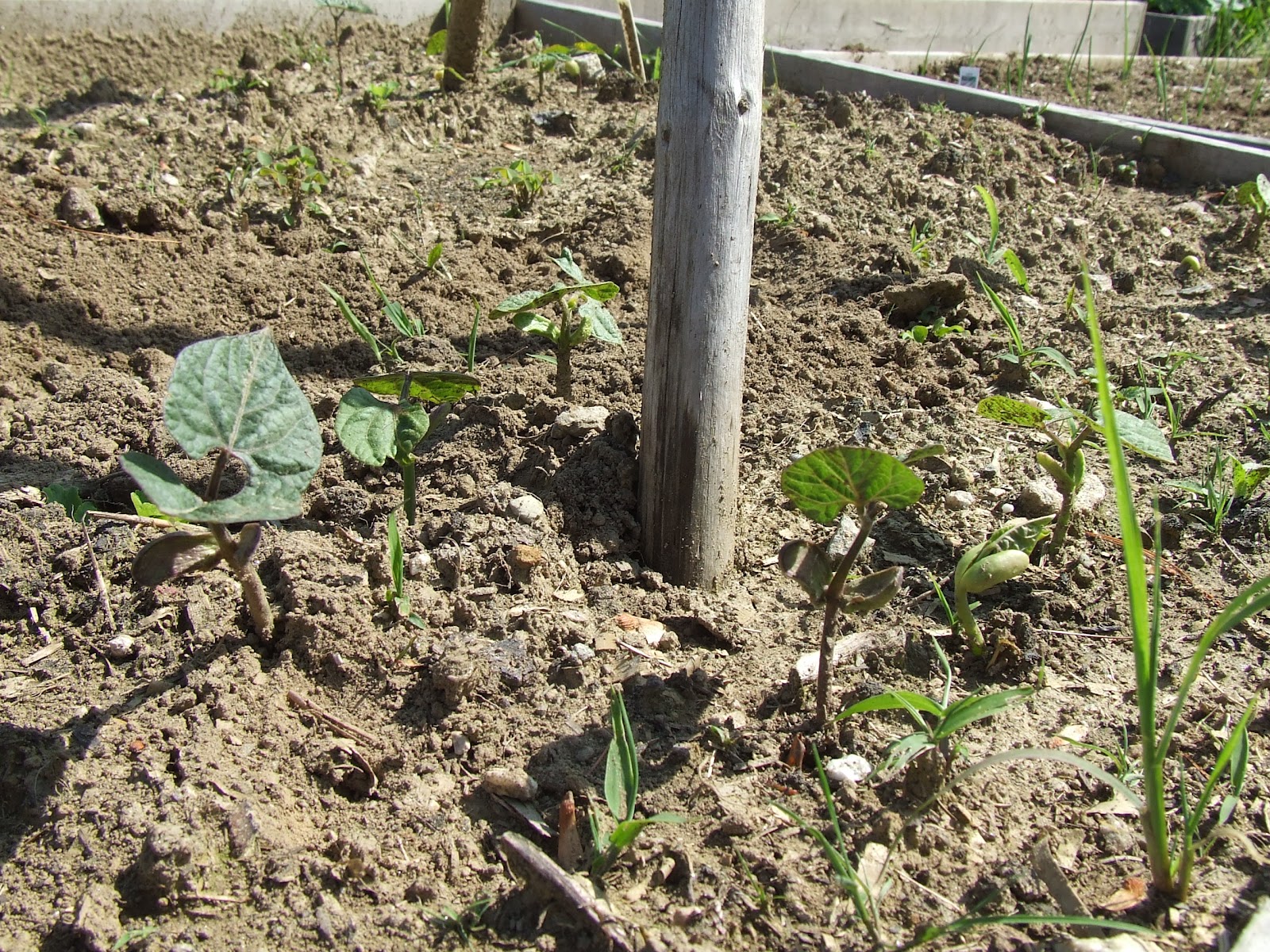 |
| Pole beans 6-10 |

 |
| Lettuce 6-10 |
 |
| Carrots and radishes 6-10 |
 |
| Chard 6-10 |
 |
| Eggplant and tomatoes 6-10 |
 |
| Rogue tomato and onion from last year's garden 6-10 |
 |
| Snap peas |
Lily has spent the past week trying to eat the bulbs that my mother planted, so Mike installed a pretty fence around the perennial garden out front to keep the dogs out. It looks lovely (he also mulched), but has been completely ineffective as far as the dogs go, and I've caught them both in there several times. Apparently the new mulch is delicious (says Lily). She can't understand why she's also banned from the vegetable garden...


Subscribe to:
Posts (Atom)